Author: Leigh Rivers
Series: The Edge of Darkness, Book Two
Genre: Dark romance and romantic suspense
My rating: ★★★½☆
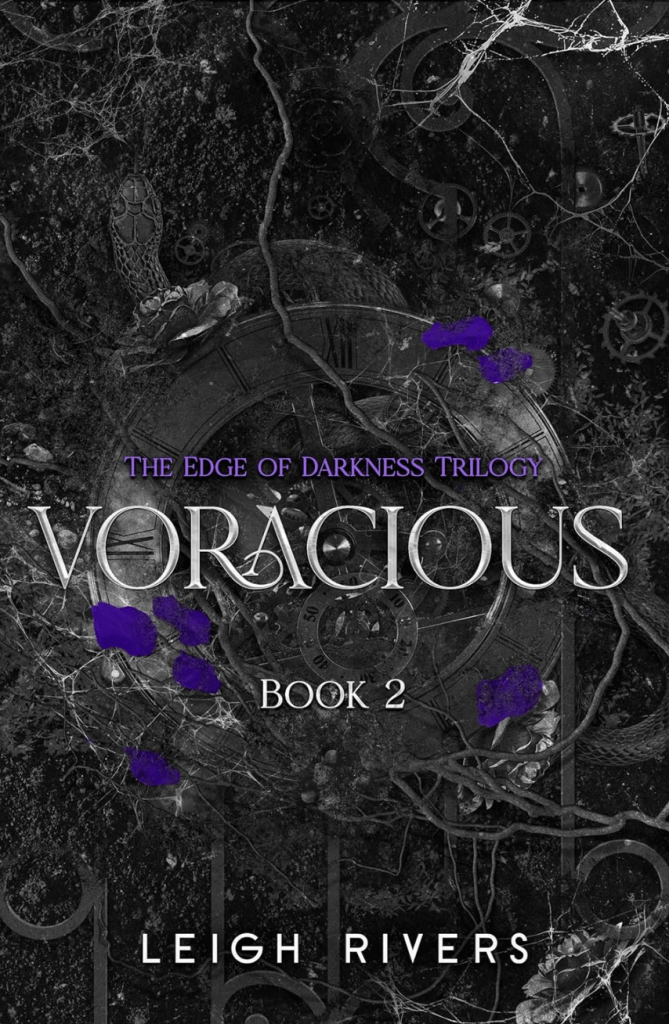
I think I enjoyed Voracious. In fact, I must have done, because I devoured it within a day and was already looking for the third book as soon as I reached the end.
Once again, Leigh Rivers leaves the story on a cliffhanger, so there was very little chance of me finishing this instalment and calmly moving on with my life.
By this point, I am becoming increasingly invested in Kade, Stacey and the wider group of characters. I need answers, I need certain people to face the consequences of their actions, and I need to know how this extraordinarily messy story ends.
However, while Voracious was undeniably addictive, there were also parts that left me confused or unconvinced.
A very important content warning
Like the first book, Voracious is an extremely dark romance containing explicit sexual content and potentially distressing themes.
The series explores abuse, coercion, sexual violence, trauma, torture, controlling behaviour and other forms of physical and psychological harm.
This is not simply a romance with a brooding love interest and a slightly dangerous atmosphere. Some of its content is exceptionally heavy, so I strongly recommend reading the author’s complete warnings before beginning.
There may also be some minor spoilers throughout this review, particularly when I discuss aspects of the plot that did not entirely make sense to me.
What is Voracious about?
Voracious continues the story of Kade and Stacey following the revelations and cliffhanger at the end of Insatiable.
Their relationship remains tangled in trauma, betrayal, obsession and years of unanswered questions. As more details about their separation begin to emerge, both characters are forced to confront what really happened and who has been manipulating them.
Stacey is still trying to escape the people who have controlled and abused her, while Kade continues to unravel under the weight of his own trauma.
Around them, the danger becomes more intense, more secrets are exposed and the line between protecting someone and controlling them becomes increasingly blurred.
My thoughts
This was another incredibly fast read.
Whatever criticisms I have, Leigh Rivers clearly knows how to keep a reader turning the pages. The chapters often end at exactly the right moment to make stopping feel impossible, and the ongoing mystery made me want to find out what had really happened to the characters.
I am also much more invested in the wider cast now.
The friendships and loyalties surrounding Kade and Stacey help give the story some emotional depth beyond the central romance. I have started caring about what happens to all of them, rather than reading solely to discover whether Kade and Stacey eventually find their way back to one another.
That investment is probably the main reason I am already planning to read Restitution.
Addictive, but occasionally repetitive
Although I finished the book in a day, I did catch myself skim-reading parts of it.
That seems slightly contradictory, but I think it reflects my overall experience quite well. I was invested in the outcome and desperate for answers, yet not every scene held my attention equally.
Some sections felt repetitive, particularly when the characters returned to the same arguments, emotional reactions and destructive patterns.
I understand that trauma does not disappear neatly and that both characters are deeply damaged by what they have experienced. However, there were times when the story seemed to circle the same conflicts without moving them forward enough.
I wanted to reach the next revelation, confrontation or important development, which sometimes meant moving more quickly through the scenes between them.
Some confusing plot decisions
There were also a few parts of the story that did not entirely add up for me.
The biggest question was how nobody seemed to know about Stacey’s second stepbrother, Chris.
Considering how central he is to her trauma and how extensively other characters investigate her life, it felt strange that his existence had apparently remained hidden. Perhaps there is an explanation I missed or one that will become clearer in the final book, but it left me wondering how such a significant person had escaped everyone’s attention.
I was also confused by Stacey receiving a new identity while continuing to visit Kade’s father in prison.
If somebody is genuinely in hiding and attempting to disappear, regularly visiting a known connection in prison does not seem like the safest decision. Prison visits are hardly anonymous, so it felt like the sort of behaviour that could expose her new identity relatively quickly.
Dark romance naturally requires some suspension of disbelief, but these details distracted me because they affected the credibility of the wider plot.
Are the characters too young?
I am also not completely convinced by Kade and Stacey being only 21.
Perhaps this is simply because I am reading the series as someone slightly older, but their ages increasingly feel at odds with the scale of the story.
The characters have experienced an enormous amount, hold significant power and make decisions that seem better suited to people with a little more life experience. Kade, in particular, often feels written as someone older than 21.
I am not suggesting that they needed to be middle-aged. Even placing them in their mid-to-late twenties might have made their positions, resources and behaviour feel more believable.
Their emotional immaturity does make sense in light of their trauma, but the longer the series continues, the more I find myself wishing they had been written as slightly older characters.
The romance and character investment
Kade and Stacey’s relationship remains intense, obsessive and deeply unhealthy.
At times, that intensity is exactly what makes the story compelling. Their shared history and unresolved feelings give every interaction an emotional charge, and it is clear that neither has ever truly moved on.
At other times, their refusal to communicate becomes frustrating.
They are surrounded by lies, misunderstandings and manipulation, but they also repeatedly make situations worse by withholding information or acting without considering the consequences.
I still want them to find some form of peace, although I am not always convinced that being together is the healthiest route towards it.
That tension is part of what keeps the series interesting. I am invested in their relationship while simultaneously questioning almost every decision they make.
Does it work as the middle book?
Voracious feels very much like the second instalment of a trilogy.
It expands the characters’ histories, reveals more about the forces working against them and moves them towards the final confrontation. However, it does not provide much closure of its own.
The cliffhanger makes the third book feel essential rather than optional.
That worked on me because I immediately wanted to continue, but readers who dislike unfinished stories may be better off having Restitution ready before beginning.
My final verdict
Voracious was dark, dramatic and extremely addictive.
I finished it within a day, became more invested in the characters and immediately wanted the final book. Clearly, the series is doing something right.
However, I also skimmed through certain sections, questioned some of the plot logic and struggled to believe that the central characters were only 21.
It is an enjoyable series, and I am curious enough to see it through to the end, but I have read stronger dark romances with tighter plots and more convincing character development.
I may not think it is perfect, but the fact that I am already reaching for book three says plenty.
My verdict: An addictive but uneven sequel that deepened my investment, even when the plot left me questioning the logic.
 The Curvy Bookworm